Recently in Thunderbird Category

Thanks to Gary for having made me notice this was blog worthy.

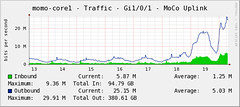
We've recently released Thunderbird 3 Beta 1, and afterwards, I had a look at our traffic graphs for the Mozilla Messaging website during that period.

See for yourself, can you see when we released Beta 1?

We have a planet!

|

It's actually been a couple of days, but I am just getting around to announcing it.

Mozilla Messaging now has it's own planet, planet.mozillamessaging.com, aggregating blog feeds from various Thunderbird sources. It's a complete ripoff copy of Planet Mozilla, just with different feed configuration.

It should get redesigned at the same time as the next incarnation of our main web site, so pay little attention to what it actually looks like, and just subscribe to the feed already.

Cheers.

P.S. If you feel like your feed (or a feed you like) should be on there, file a bug asking for it to be added

toirneach éan

|
toirneach ean

I've been recently working on bug 449202: Get Thunderbird L10N builds working on comm-central. It's been mostly about using KaiRo's existing work for SeaMonkey and s/SeaMonkey/Thunderbird/g in the right places.

Ran into a few more problems, mostly my fault, and some having to do with the way the MoCo build network is setup.

Turns out it's also fairly complex to test this stuff, as the current setup relies on notifiers kicking on changes to the l10n repositories, so triggering a l10n build on purpose is a bit tricky. Instead, it was simpler to just wait for somebody to change something in one of the many l10n repositories and see what happens.

Well, I am happy to report that the first localized build of Thunderbird since the move to Mercurial has been produced and can be downloaded. It's only a single build, and for Windows, but more will follow as the normal churn in l10n repositories will trigger some more.

Then, the fun begins tonight, as the nightly builders should trigger a build of all of Thunderbird supported locales in one go. So, by tomorrow morning, we should have tons (43 locales per platform, to be precise) of new localized builds waiting for us, sweet!

Oh, and in case you had been wondering, the first successfull build is here. I think it's pretty cool that the first locale that successfully build turned out to be ga-IE, so that will explain the topic of this post. Hopefully, somebody from that locale will understand the title (and apologies if I butchered your language, feel free to correct me please)

Thunderbird code size shrinks by 1.66Gb!

|
Tinderbox-Thunderbird-osx-mZdiff

First, that's only on OS X, sorry for folks running it on a different platform. Second, it's a bit of a lie, as I am talking about bug 448003.

Since we switched over to building from Mercurial, the code size tests we run were somewhat off on OS X. These tests basically measure the size of the code included in the product. For instance, right now, on Linux, it's reported at 15.7MB.

However, on OS X, they had been reporting 1.56GB! Obviously, this was a bug somewhere in the computation of this number, not the actual code size, so that's why the subject of this post is appropriately misleading.

Tinderbox-SeaMonkey-osx-mZdiff

Various hypothesis were put forward, including the fact it looked like it was off by precisely 100, so possibly a unit conversion problem, or something similar.

I've finally gotten around to it, and after some investigation, turns out it's more interesting than that. On OS X, we don't directly build universal binaries, but instead build once for i386 and once for ppc, then lipo the 2 builds together to form the final product.

To determine code size in this case, it would be misleading to count both architectures, so instead we pick one and size up that one. In our case, for historical reasons, that's the ppc version, even though our build boxes are Intel by now. Determining code size is done by parsing the output of /usr/bin/nm, an object dumping tool that nicely dumps the symbols list out of libraries and executables. Unfortunately, it dumps positions in the code, not size. So, to determine code size for a given function, just make sure addresses are sorted, then subtract the address of the previous function to the address of the current function, and you'll get the number of bytes that it takes up in the object file. Simple, right ?

Well, for some reason, not yet explained, on ppc, there is a strange symbol called trampoline_size that exists first in the list of symbols and sits at address '0'. However, right after it is the next symbol, strangely sitting at the address 0x20000000. That's 536870912 bytes further, if we believe what this is telling us. Of course, this is bogus. I am not entirely certain what this about, but if I could venture a guess, I'd have to say it has to do with the ppc executable format, OS X, and their ability to transparently run ppc binaries on Intel. Anybody that knows OS X/PPC better than me, feel free to correct me on this.

libnspr4.dylib: 00000028 a trampoline_size
libnspr4.dylib: 20000000 t __mh_dylib_header
libnspr4.dylib: 20001a7c t dyld_stub_binding_helper

Now that the problem is somewhat understood, it was a simple matter of teaching the code size stuff to ignore symbols like that on OSX/ppc and start at the next one. As you can see from the Tinderbox boxes, it was still pretty impressive to see such a large code size decrease! Oh, and SeaMonkey got the same drop in size, for the same reason.

About this Archive

This page is a archive of recent entries in the Thunderbird category.

Infrastructure is the previous category.

Find recent content on the main index or look in the archives to find all content.

Pages

  • mozilla
  • uploaded

December 2008

Sun Mon Tue Wed Thu Fri Sat
  1 2 3 4 5 6
7 8 9 10 11 12 13
14 15 16 17 18 19 20
21 22 23 24 25 26 27
28 29 30 31